Is Homeio an alternative to Olares?
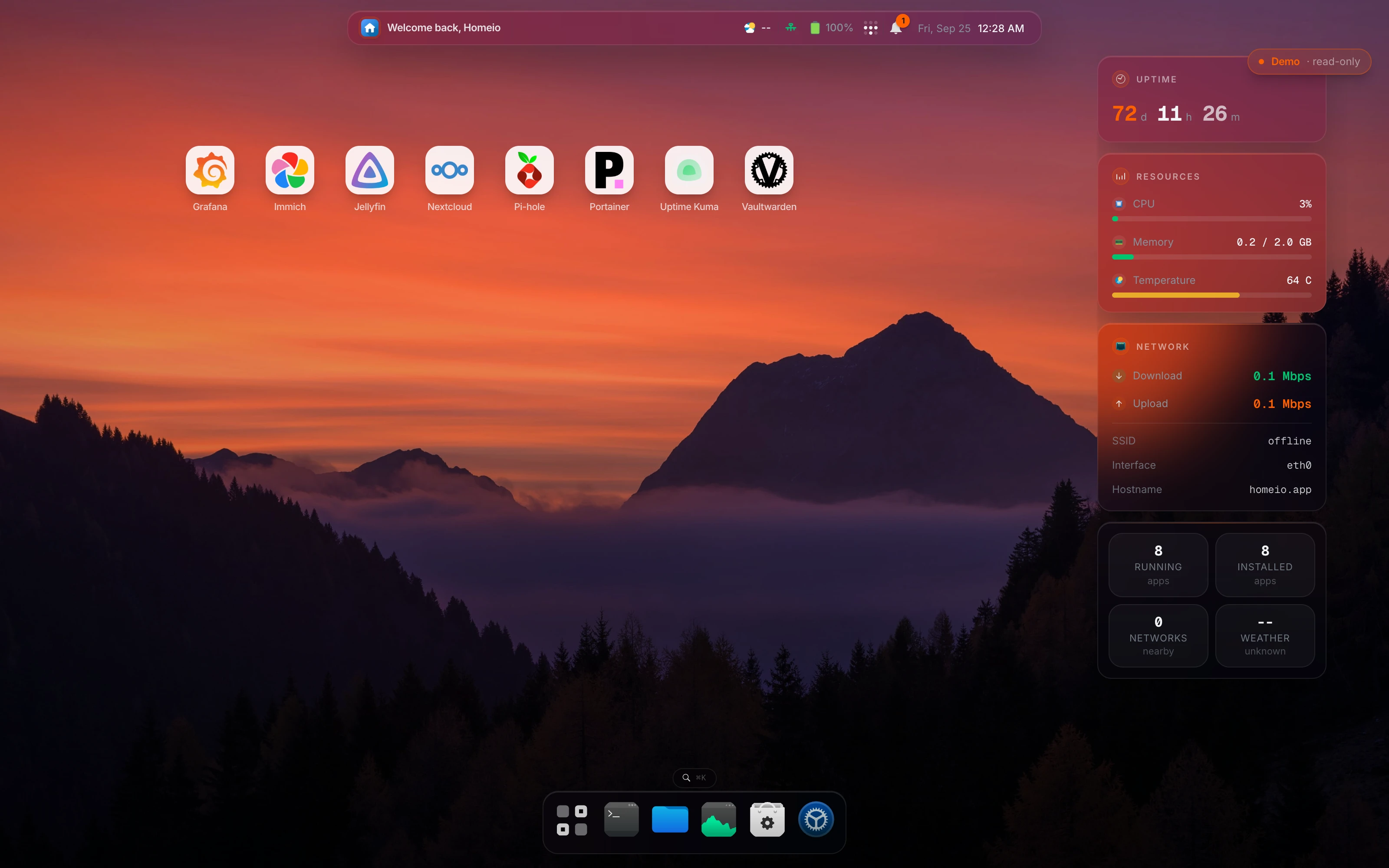
Yes, if what you want is self-hosted apps on a Linux machine rather than a personal AI platform. Olares is a full personal cloud OS on Kubernetes, with its own identity system, a GPU scheduler and a focus on running AI agents and models locally. Homeio is smaller: a Docker Compose app store plus files, disks, Samba, scheduled tasks, backups and monitoring.
What hardware does each need?
Olares's Linux install asks for at least 4 CPU cores, 8 GB of free memory and 150 GB of SSD storage, and fails on a hard drive; a GPU is optional for AI. Homeio runs on a Raspberry Pi 4 or 5, an N100 mini PC or an old desktop: its Docker install caps Homeio itself at 1 GB, and 4 GB of RAM leaves room for a few apps.
Do I need an account to use either one?
For Olares, yes: you create an Olares ID in the LarePass app to activate the server, and by default reach your desktop at an address under olares.com based on that ID. Homeio uses one local account created on first launch, and no online account is involved; remote access is Tailscale or Cloudflare Tunnel, which you turn on only if you want it.
When is Olares the better choice?
When local AI is the point. Olares installs AI apps and models from its Market in one click, pools GPUs across machines with time-slicing and memory-slicing, and is designed for AI agents that work with your files. It also serves several users, with private networking, HTTPS entrances for apps and a password vault built in. Homeio has one account and no AI runtime of its own.
Why choose Homeio instead?
Because it is less platform. Every Homeio app is a docker-compose.yml you can read, edit and copy to another host; when an app misbehaves you read its logs, not pod events. It runs on small hardware, manages the host too (disks, Samba shares, Wi-Fi, scheduled tasks), and nothing depends on an external identity service.
Are both open source?
Yes, and under the same licence. Olares and Homeio are both AGPL-3.0: free to use, change and redistribute, and anyone who ships a modified version or runs one as a service must publish their changes. Olares builds on Kubernetes (K3s), Kubesphere, JuiceFS, MinIO, Envoy and other open-source projects.
Can I run my existing Docker Compose apps?
In Homeio, directly: paste the Compose file or a docker run command as a custom app, or keep running it yourself and Homeio shows the container on its desktop, read-only. Olares runs apps on Kubernetes, so a Compose app has to be packaged for Olares Market first.
How do I install Homeio?
curl -fsSL https://get.homeio.app | sudo bash on Debian, Ubuntu or Raspberry Pi OS, which serves the UI on port 80, or docker compose up -d from a clone of the repository, which serves it on 12026. The first account you create is the only one.